Everyday Wilder Living: printable card set
A sample of 4 cards. The full set of 43 comes with the collection. Back
Live wilderHandling a folding handsaw

Step by step

  1. With the blade closed, get to know your folding saw's parts: the blade, handle, locking button, lanyard hole, teeth, and the spine and sides of the blade. Check your saw's own instructions, as locks differ between makes.
  2. To open it, hold the saw in your dominant hand with the locking button facing you and the spine of the closed blade towards your other hand.
  3. Press the button with your thumb, and with your other hand grip the flat sides of the blade, never the teeth, and pull it open until it clicks and locks fully.
  4. Check it is locked by gently pressing the spine. Never use a saw that will not lock.
  5. To close it, hold the saw with the button facing you and the teeth facing away from your other hand. Press the button and push the blade closed by its flat sides until it locks shut.
  6. Always carry and store the saw closed.
The full Wilding activity guide (what you need, safety, variations and questions to wonder about): re-wild.co.uk/g/handling-a-folding-handsaw/
Everyday Wilder Living · re-wild.co.uk
Live wilderHandling & using a pair of loppers

Step by step

  1. Inspect the loppers and check the actual tool’s operating limits and maintenance instructions. Do not use damaged or dull blades; maintenance is a separate task.
  2. Put on protective gloves, and safety goggles if cutting near your face or where debris might fly.
  3. Hold one handle in each hand using the designed grips. Keep the opening and closing arc clear of your body and other people; no universal top-hand/bottom-hand rule applies.
  4. Stand in a stable position, away from other people or pets, and identify what you plan to prune, avoiding anything too thick, which needs a saw instead.
  5. Set the appropriate stem in the cutting position and close the handles with controlled arm pressure. Do not lean your weight onto them, twist the blades or force an oversized stem. Stop and select a saw if the cut cannot be made within the tool’s capacity; keep this task below shoulder height.
  6. Check the cut is clean, and clear away any debris to prevent trip hazards.
  7. After use, wipe the blades clean of sap and debris, apply a drop of oil to the pivot point, and store the loppers somewhere dry.
The full Wilding activity guide (what you need, safety, variations and questions to wonder about): re-wild.co.uk/g/handling-and-using-a-pair-of-loppers/
Everyday Wilder Living · re-wild.co.uk
Live wilderGetting to know a sheath knife

Step by step

  1. Familiarise yourself with the knife's parts: the handle, the handle guard, the blade, the cutting edge, the bevel, the spine of the blade, and the blade tip. To remove the knife from its sheath, whether attached to a lanyard or not, orientate it at right angles to your body with the cutting edge facing away from you.
  2. Hold the sheath firmly in your non dominant hand, thumb underneath and fingers along the top, making sure your thumb and fingertips sit behind where the blade's cutting edge will be, sometimes called making a sock pocket.
  3. Place the tip of your dominant thumb, slightly bent, on the sheath where its back meets the back of the knife handle, gripping the front of the handle with your remaining fingers.
  4. Push against this part of the sheath to straighten your thumb while gently and slowly pulling the handle out.
  5. Once the knife feels loose but still covered by the sheath, stop and adjust your grip so your thumb rests on the back of the handle and your fingers wrap around it.
  6. Pull the knife fully clear, then settle into a fist grip, with your thumb resting on top of your index finger. Rotate the knife 90 degrees so it is vertical, tip pointing up.
The full Wilding activity guide (what you need, safety, variations and questions to wonder about): re-wild.co.uk/g/getting-to-know-a-sheath-knife/
Everyday Wilder Living · re-wild.co.uk
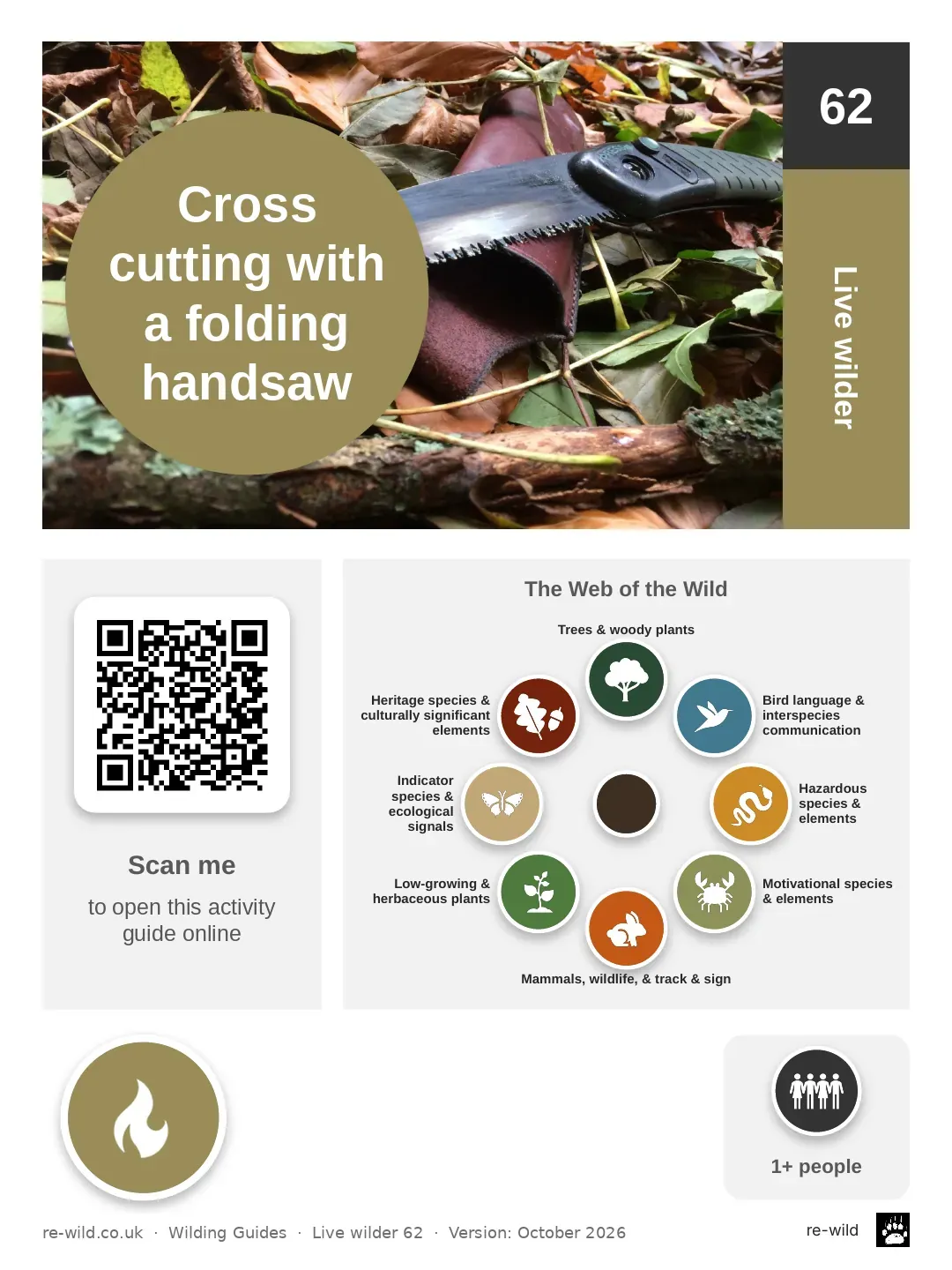
Live wilderCross cutting with a folding handsaw

Step by step

  1. Rest your length of roundwood on a wood block so that the cut will open up under its own weight as you saw. Wedge or secure it so it cannot roll.
  2. Open the saw until it locks, and gently place the teeth on the spot you want to cut, outside the block so the offcut falls away from your feet.
  3. To protect your hands if the blade slips, cross your arms: bring your non-dominant hand over the top of the hand holding the saw and hold the wood firmly, well away from the blade.
  4. With light pressure, slowly draw the blade back towards you a few times to start a groove, then use smooth, full-length strokes to cut. Most folding saws cut on the pull stroke.
  5. Once the blade is buried in the cut it is less likely to jump, and you can uncross your arms if you wish, keeping your hand well away from the blade.
  6. As you near the end, lighten the pressure and use shorter strokes, and let the offcut fall clear.
  7. After cutting green or sappy wood, wipe the blade, lightly oil it, and close it until it locks.
The full Wilding activity guide (what you need, safety, variations and questions to wonder about): re-wild.co.uk/g/cross-cutting-with-a-folding-handsaw/
Everyday Wilder Living · re-wild.co.uk