The Invisible Wild: printable card set
A sample of 4 cards. The full set of 72 comes with the collection. Back
Imaginatively journalTracking journal

Step by step

  1. Venture into a wild space and find a track you do not immediately recognise.
  2. Sketch and measure the track from above and in cross section, shading in its deepest parts and looking closely for any displaced material.
  3. Use the 6 arts of tracking to prompt yourself to notice every detail. Is it a left or right foot, front or rear? Notice the length of each toe, the sharpness of any claws, and the pattern of the gait.
  4. Record your answers on the journal page next to your sketch, then draw a wider view of the surrounding 5 metres for context, marking north, the direction of travel, and nearby plants, trees, soil and terrain.
  5. Use a field guide to research which animals could be responsible, and note their typical behaviour and habits.
The full Wilding activity guide (what you need, safety, variations and questions to wonder about): re-wild.co.uk/g/tracking-journal/
The Invisible Wild · re-wild.co.uk
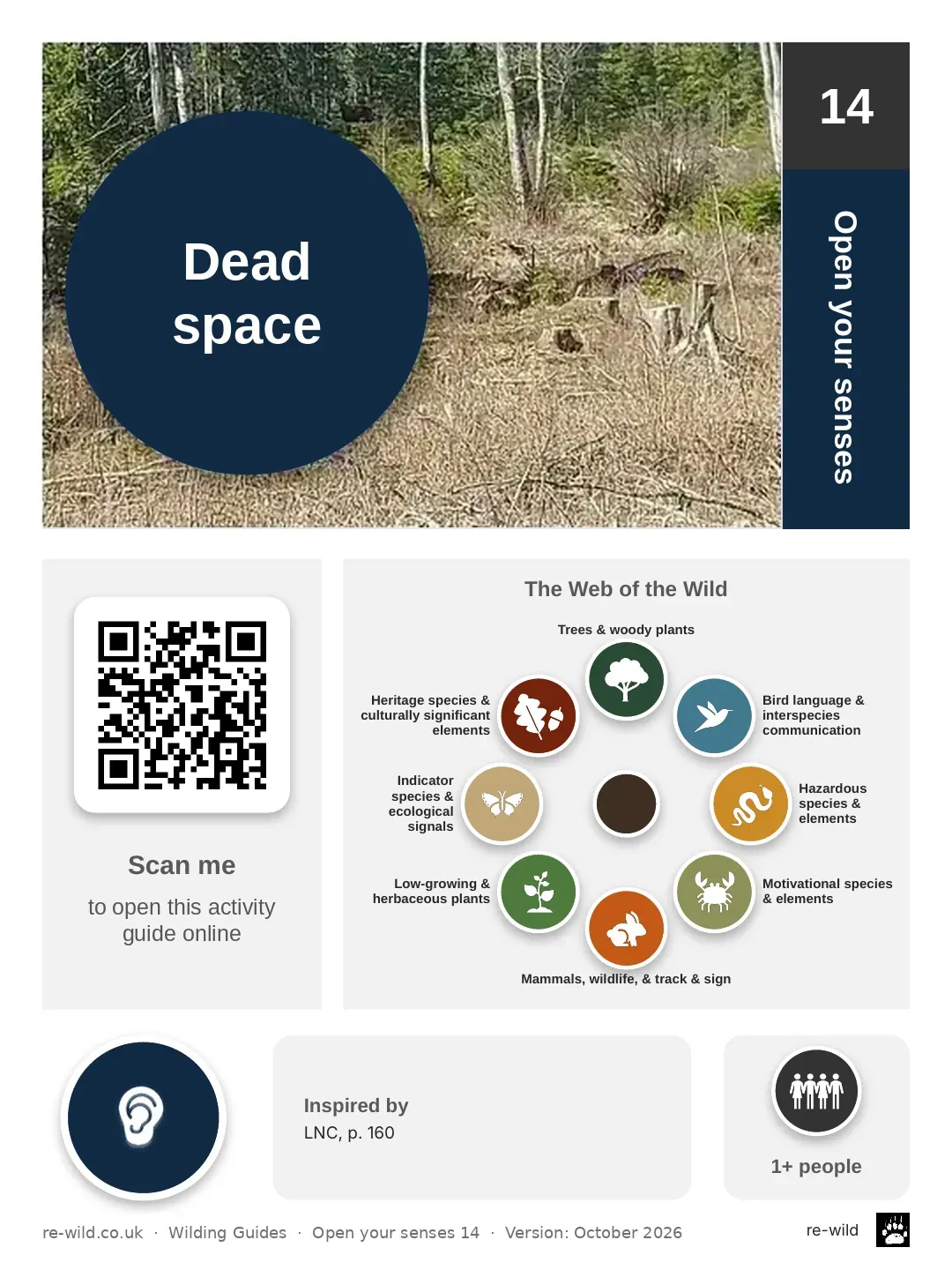
Open your sensesDead space

Step by step

  1. Find a vantage point overlooking a mixed landscape, such as a valley, field edge or clearing. Study the scene carefully and try to spot areas of dead space, also called dead ground. These are patches of land hidden from your view by dips, banks, plants or other features, even though the wider area looks open.
  2. Mark these dead spaces on a simple sketch map, or point them out to a partner.
  3. Consider how an animal, or a person trying to move unseen, could use this dead ground to approach closer without being spotted.
The full Wilding activity guide (what you need, safety, variations and questions to wonder about): re-wild.co.uk/g/dead-space/
The Invisible Wild · re-wild.co.uk
Track & ask questionsHow to make a tracking stick

Step by step

  1. Cut a stick to about 1 metre long. Shave a gentle chamfer onto the end you will hold while walking.
  2. Carve a rounded point on the other end and harden it briefly in a fire. Starting from the pointed end, make 10 marks spaced 100 millimetres apart, carving a small notch around the stick at each mark. Near the handle end, drill or carve a small hole through the stick. Weatherproof the whole stick with a natural oil or beeswax.
  3. Thread a length of cordage through the hole, tie it off with a secure knot, and use it as a wrist strap. Slide 3 to 5 rubber bands onto the pointed end, ready to use as sliding markers.
The full Wilding activity guide (what you need, safety, variations and questions to wonder about): re-wild.co.uk/g/how-to-make-a-tracking-stick/
The Invisible Wild · re-wild.co.uk
Track & ask questionsTrack tracer

Step by step

  1. Find a clear animal track. To protect it, lay 2 sticks on either side of the track and rest a sheet of rigid, clear Perspex on top of them so it hovers just above the track without touching it.
  2. Use a marker pen to trace the outline and features of the track directly onto the Perspex.
  3. Once you are back home, transfer this tracing into your tracking journal by tracing it again from the Perspex.
The full Wilding activity guide (what you need, safety, variations and questions to wonder about): re-wild.co.uk/g/track-tracer/
The Invisible Wild · re-wild.co.uk