Wild Wise: printable card set
A sample of 4 cards. The full set of 116 comes with the collection. Back
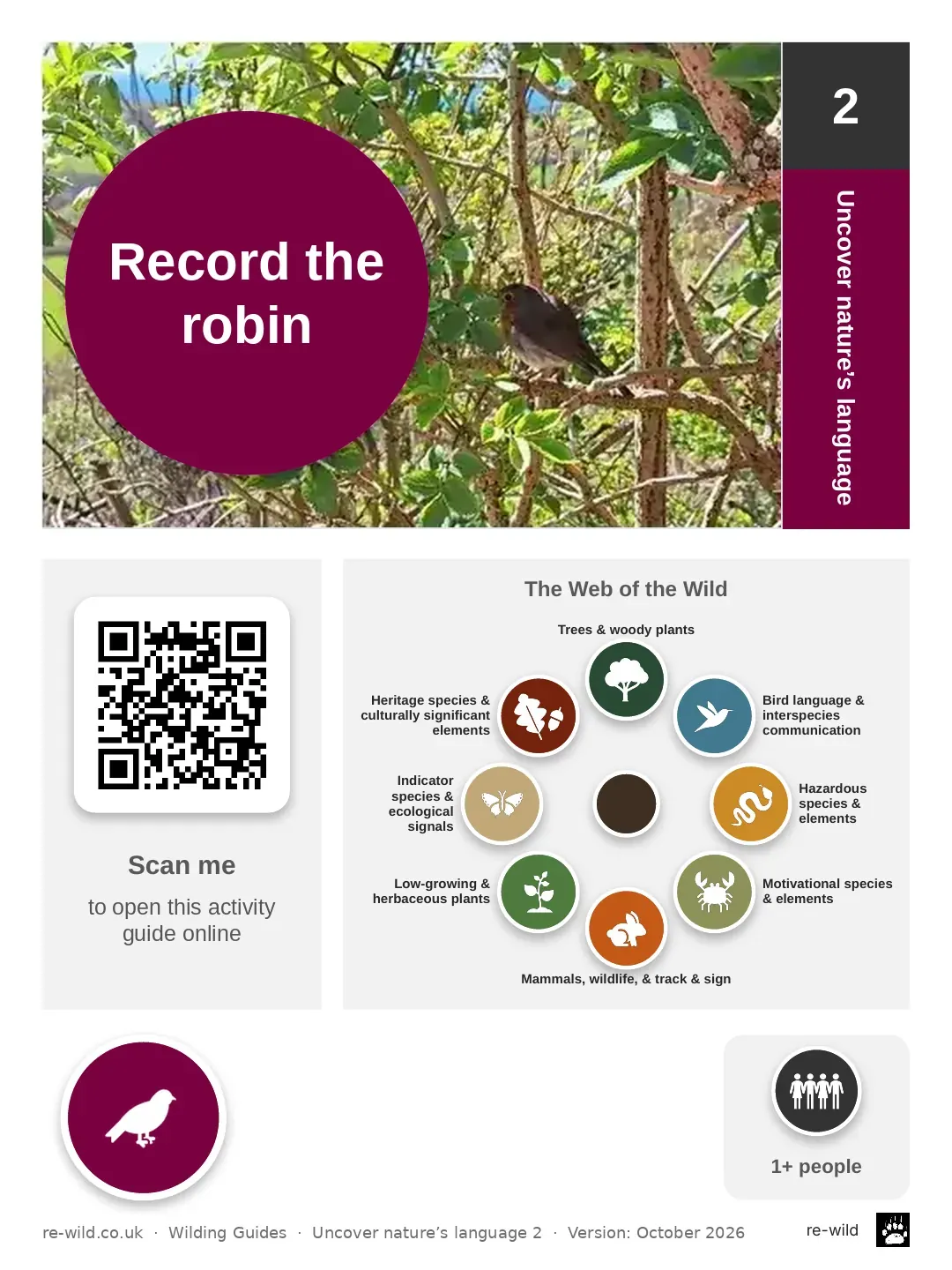
Uncover nature's languageRecord the robin

Step by step

  1. The robin is one of the few British birds that sings almost all year round, which makes it an ideal first voice to learn.
  2. Find a robin that sings regularly near your home or sit spot.
  3. Using the voice recorder on your phone, record a minute or two of its song, and note the date, time, place and weather.
  4. Repeat this once a month for a whole year, at roughly the same time of day.
  5. Listen back to your recordings in order.
  6. Notice how the song changes, from the strong, confident song of spring to the thinner, more wistful song of autumn and winter.
  7. Listen too for its other voices, such as the sharp tick of alarm and the thin, high seep call.
The full Wilding activity guide (what you need, safety, variations and questions to wonder about): re-wild.co.uk/g/record-the-robin/
Wild Wise · re-wild.co.uk
Uncover nature's languageMy blackbird teacher

Step by step

  1. Choose 1 bird species, such as a blackbird, that is common near you, and commit to getting to know its voice well over time. Each time you hear it, pause and listen closely, trying to identify which of its voices you are hearing, such as its song, a contact call, or an alarm.
  2. Keep a simple log of what you hear and when, building up your familiarity over weeks and months.
The full Wilding activity guide (what you need, safety, variations and questions to wonder about): re-wild.co.uk/g/my-blackbird-teacher/
Wild Wise · re-wild.co.uk
Dive into field guidesHave a guess

Step by step

  1. Choose a place you know, such as a hedge, pond or patch of woodland. Before you look closely, guess what you are likely to find there, thinking about the habitat, the season and the time of day.
  2. Then explore the spot properly and see how many of your guesses turn out to be right.
The full Wilding activity guide (what you need, safety, variations and questions to wonder about): re-wild.co.uk/g/have-a-guess/
Wild Wise · re-wild.co.uk
Uncover nature's languageBird behaviour matching

Step by step

  1. Spend some time out and about getting to know common bird behaviours. Look for birds feeding on the ground, in trees or in flight, stealing food and chasing off rivals. Watch for singing from a perch or in flight, gathering nest material, building a nest and feeding chicks. Notice robbing another nest, defending a nest, youngsters begging, calls to companions, flock calls and alarm calls. Each time you spot a bird, try to match what you see to one of these behaviours.
  2. Ask yourself how this behaviour fits the bigger picture, such as the time of day, the weather, or the season. Aim to spend at least a few minutes each week simply watching and noticing what birds around you are doing.
The full Wilding activity guide (what you need, safety, variations and questions to wonder about): re-wild.co.uk/g/bird-behaviour-matching/
Wild Wise · re-wild.co.uk