The 28-day Sit Spot Journey: printable card set
A sample of 4 cards. The full set of 29 comes with the collection. Back
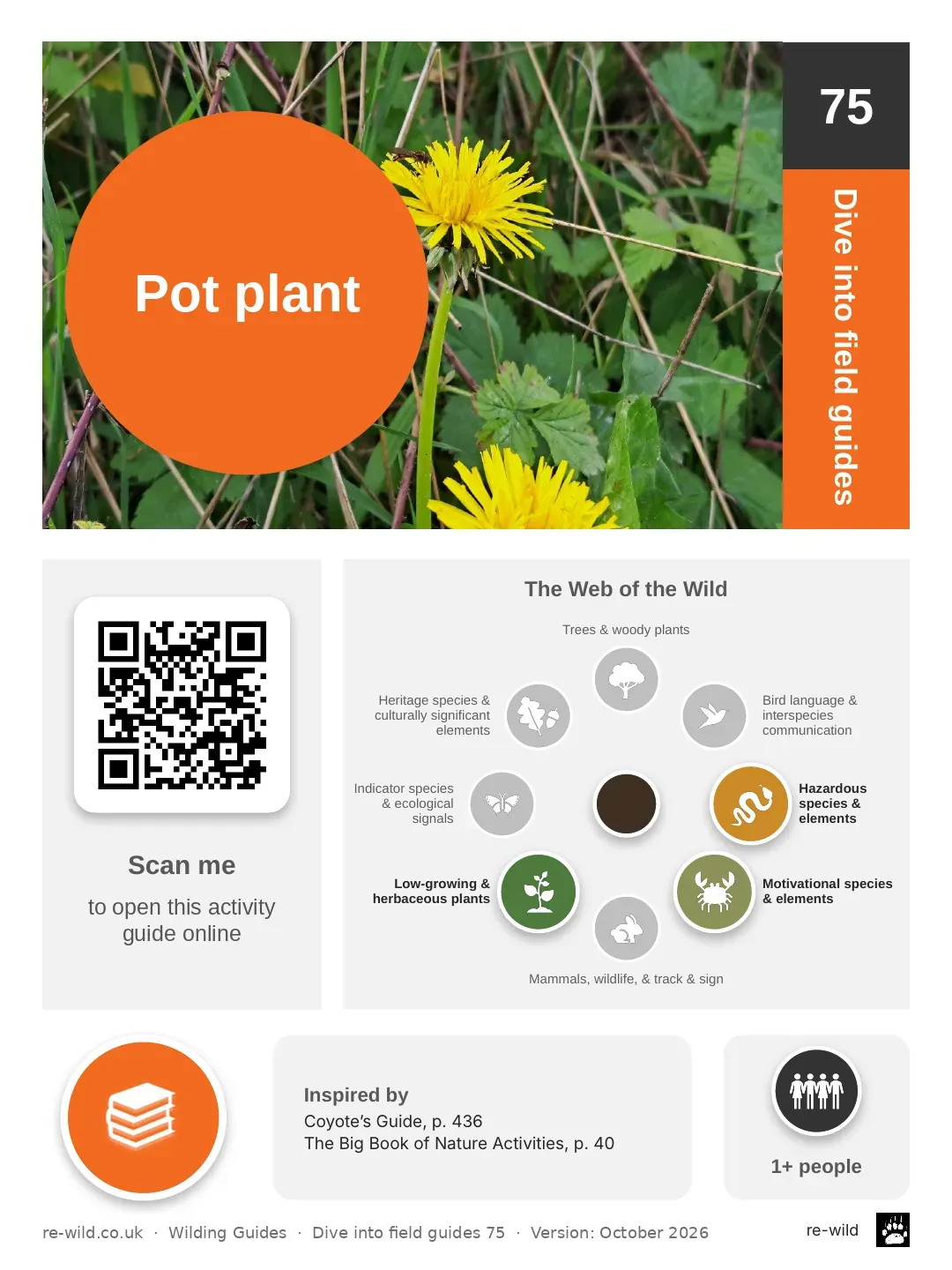
Dive into field guidesPot plant

Step by step

  1. Choose a perennial plant, which is one that lives for several years, and gather or buy a little of its seed. Yarrow, ox-eye daisy, foxglove and primrose are good choices.
  2. Fill a pot with peat-free compost, sow the seed as the packet or a field guide suggests, and water it gently.
  3. Keep the pot somewhere you pass every day, such as a doorstep or windowsill.
  4. Watch for the first seed leaves and then the basal leaves, which are the leaves that grow in a rosette close to the soil.
  5. Follow your plant as it sends up a stem, flowers, sets seed and dies back for the winter. At each stage look for patterns, such as how the leaves are arranged, the shape of the stem, the number of petals and how the leaf shape changes up the plant.
  6. Record what you see in your journal.
The full Wilding activity guide (what you need, safety, variations and questions to wonder about): re-wild.co.uk/g/pot-plant/
The 28-day Sit Spot Journey · re-wild.co.uk
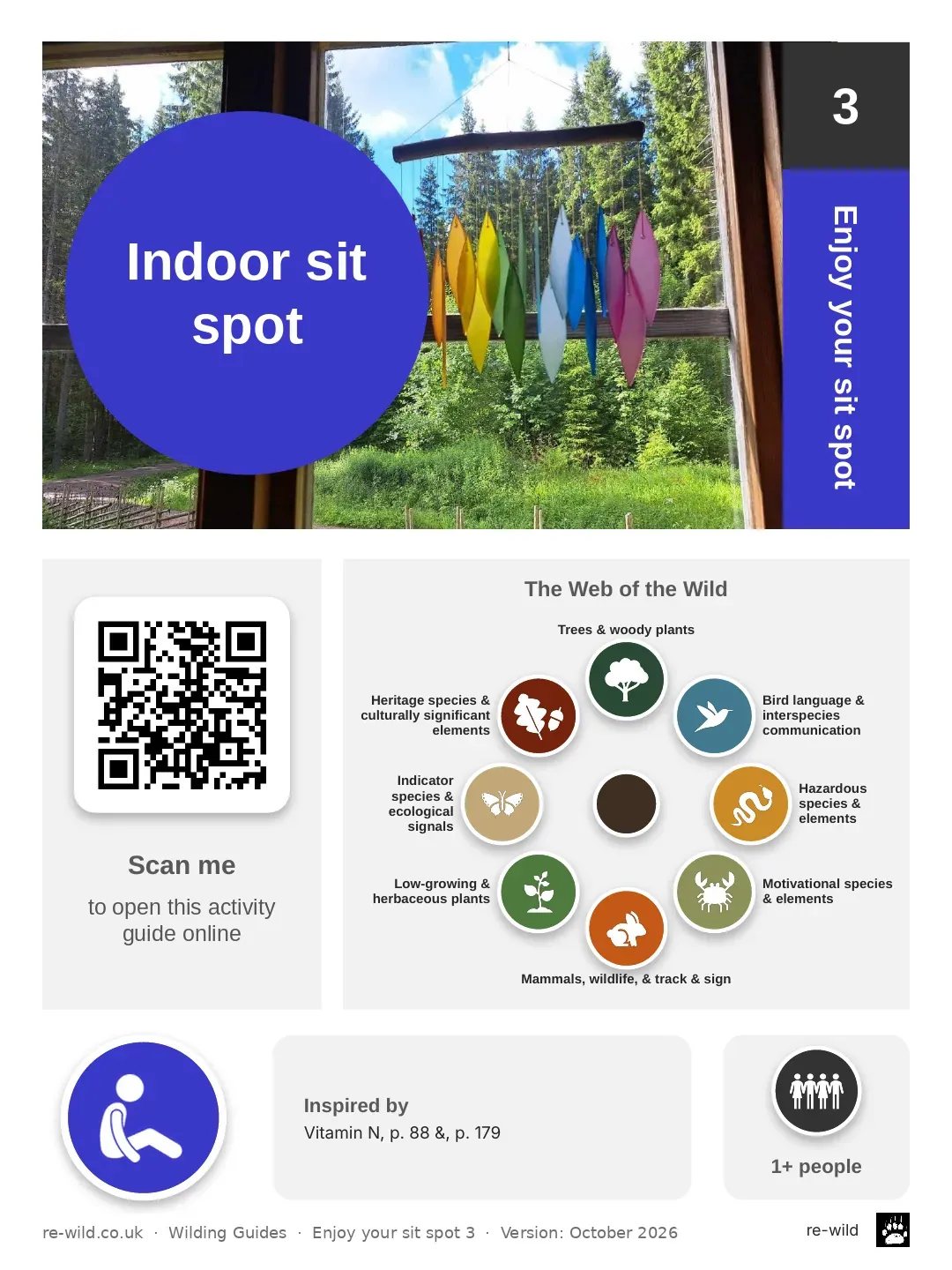
Enjoy your sit spotIndoor sit spot

Step by step

  1. Set up a wild watching window somewhere you can see the moon, clouds, birds or other natural activity.
  2. Find a comfortable spot near this window and settle in, trying to stay motionless for at least 30 minutes.
  3. Afterwards, share your story with someone who is an excellent listener, or record it another way, such as journaling or mapping what you noticed.
The full Wilding activity guide (what you need, safety, variations and questions to wonder about): re-wild.co.uk/g/indoor-sit-spot/
The 28-day Sit Spot Journey · re-wild.co.uk
Create cultureNature connectedness index

Step by step

  1. The Nature Connection Index was developed by the University of Derby's Nature Connectedness Research Group to measure how connected to nature a person feels.
  2. Find the six short statements in question thirty of Your Baseline, at the front of the Wilding Companion.
  3. Read each statement and score it from one, completely disagree, to seven, completely agree, going with your first honest response.
  4. Add up your six scores to give a total between six and forty two.
  5. Write down the total and the date.
  6. There is no pass mark, so treat the total as a private marker.
  7. Try the statements again after a season of practice and see whether anything has shifted.
The full Wilding activity guide (what you need, safety, variations and questions to wonder about): re-wild.co.uk/g/nature-connectedness-index/
The 28-day Sit Spot Journey · re-wild.co.uk
Venturing furtherDiscover a wild space

Step by step

  1. Look at a map of your local area, on paper or online, and search for patches of green and blue within walking or cycling distance, such as parks, woods, commons, riversides, churchyards, nature reserves and footpaths.
  2. Choose one you have never visited.
  3. Check that it is open to the public and how to get in.
  4. Pack water and suitable clothing, tell someone where you are going, and set off.
  5. When you arrive, pause at the entrance and take in your first impressions.
  6. Wander slowly, noticing the different habitats, the paths, the quiet corners and any signs of wildlife.
  7. Before you leave, find one spot you would like to return to.
  8. At home, mark the place on your map with a few words about what you found.
The full Wilding activity guide (what you need, safety, variations and questions to wonder about): re-wild.co.uk/g/discover-a-wild-space/
The 28-day Sit Spot Journey · re-wild.co.uk