re-wild
Start here What is Wilding? Activity guides How guides work Courses Shop About Jay Contact My Rucksack (0)
Who and what you meet
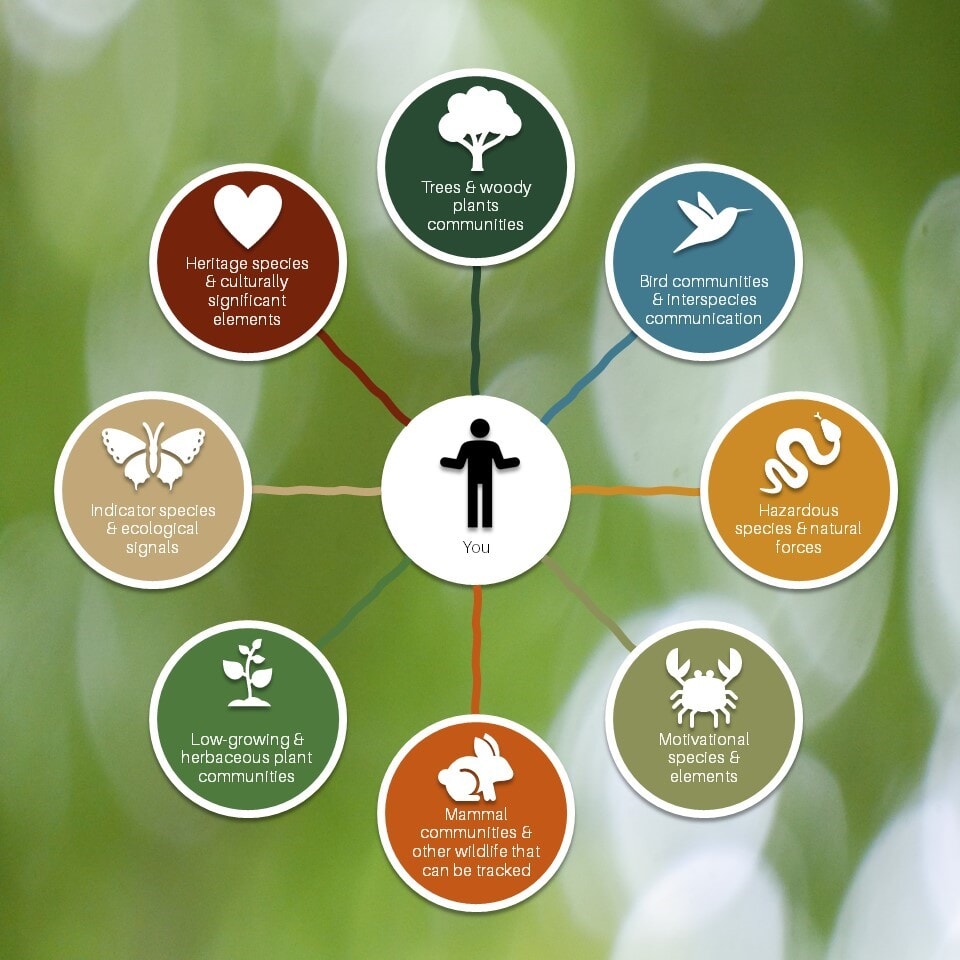
The Web of the Wild

You sit at the centre of a living neighbourhood. The Web of the Wild is a way of noticing the eight communities around you, and the relationships between them.

Tap a circle
to explore!
The Web of the Wild: eight communities of nature around youTrees & woody plant communitiesBird communities & interspecies communicationHazardous species & natural forcesMotivational species & elementsMammal communities & other wildlife that can be trackedLow-growing & herbaceous plant communitiesIndicator species & ecological signalsHeritage species & culturally significant elements

Tap any circle to step into that part of the web: who lives there, what to look for, and how to start.

Trees & woody plant communitiesOak, hazel, hawthorn and bramble: neighbours you can return to all year.Bird communities & interspecies communicationFamiliar birds can turn a place into a living conversation.Hazardous species & natural forcesRespect what can harm you and you'll see it sooner.Motivational species & elementsWhatever gets you off the settee and out of the door.Mammal communities & other wildlife that can be trackedGet to know the fox and badger long before you ever see them.Low-growing & herbaceous plant communitiesThe layer at your feet that most people walk straight past.Indicator species & ecological signalsWhat is this place trying to tell you?Heritage species & culturally significant elementsLiving nature woven into human memory and story.

Safety, and where the activity guides come from

Look after yourself and others. Outdoor activities carry real risks: fire, tools, water, weather, heights, plants, fungi, animals and getting lost. Every activity guide includes safety notes, but you are responsible for your own safety and for anyone in your care. Supervise children closely, get the landowner's permission, follow the Countryside Code, never eat anything you cannot identify with complete certainty, and only light fires where it is allowed and safe. If in doubt, leave it out.

With gratitude to the lineage. The Wilding Practice Keys and many of the activities in the activity guides have been adapted from the core routines of nature connection in the 8 Shields approach (Coyote Mentoring), mapped by Jon Young and shared in Coyote's Guide to Connecting with Nature (Young, Haas & McGown).

These ways of noticing and belonging are far older than any book. They grow from the knowledge of Indigenous and land-based peoples around the world, who have lived in close relationship with the land for thousands of years and have kept that knowledge alive, often in the face of great loss. Jon Young describes 8 Shields as built on patterns of nature connection he found in Indigenous cultures around the world, and on what his mentors taught him, including the teachings passed down through Tom Brown Jr. from Grandfather Stalking Wolf. Our own ancestors in these islands once knew the land in this way too.

I offer Wilding with deep respect and thanks to all of them. It does not claim or copy any culture's ceremonies or sacred practices. It is a UK way of carrying forward simple, shared human ways of paying attention, giving thanks and belonging to a place. — Jay

re-wild

Know nature. Live wilder. Pass it on.
Nature connection courses, guides and books.

FacebookInstagram

Explore

What is nature connection?What is Wilding?The Wilding RucksackActivity guidesHow the activity guides workCoursesSources & inspiration

re-wild

About JayContactKind wordsSafetyPrivacyTerms

© 2026 re-wild